Put priorities into everyday execution.
Service revenue, margin protection or customer care: translate goals into instructions and conditions for the relevant agents and workflows.
Business Execution Governance
Direct how AI agents across your company support your goals. Helpiner translates leadership priorities into specific rules, decisions and actions across sales, service and other teams.
For business leaders. In partnership with IT. A shared direction for your digital workforce.


A way to translate strategy and company policies into everyday AI work: which priorities agents should pursue, how they should work and under which conditions they may act.
A new leadership responsibility
Sales introduces its agents. Service adds its own. HR follows. Each team can move faster — while leadership needs their work to support the same strategy and keep pace with change.
Service revenue, margin protection or customer care: translate goals into instructions and conditions for the relevant agents and workflows.
Agents can perform different tasks. Shared knowledge, rules and approvals define how they should work together and when to hand work over.
When leadership priorities change, update the relevant instructions, knowledge and workflows. After validation, connected agents apply the changes in their subsequent work.
More agents should mean a greater ability to execute your strategy.
Value for leadership
Helpiner connects business intent, agent behaviour and execution in your enterprise systems.
Leadership sets the direction
IT enables governed execution
What you govern
A strategic goal needs specific execution rules: who acts, what they must find out, how they decide and who is responsible for the outcome.
Users, roles and the functions available to each team.
Allowed actions and the conditions attached to them.
Connected tools, systems and the data needed for the task.
Business instructions, required outputs and approval steps.
Company knowledge, documentation and relevant context.
Required details to collect from the employee before proceeding.
A user request, an event or a schedule in the configured workflow.
The responsible person, approval and records of completed actions.
Illustrative example · One priority, multiple teams
The same business priority informs different tasks in sales, service and support. Once the relevant rules and integrations are configured, each agent contributes through its own role.
For new installations, systematically offer a suitable service contract. Exceptions to pricing rules require approval from the responsible manager.
Interactive illustration of a possible configuration. It is not connected to live agents or systems.
One leadership goal → role-specific instructions → connected actions in CRM and ERP.
How it fits
Leadership sets goals and policies. In Helpiner, these inform roles, instructions, knowledge and workflows. Agents apply them when working with employees and acting in connected systems. Voice brings this way of working to people in the office and in the field.
The scope of governance follows the actions, integrations and workflows configured in Helpiner. Existing identity, security and system controls remain part of the implementation.
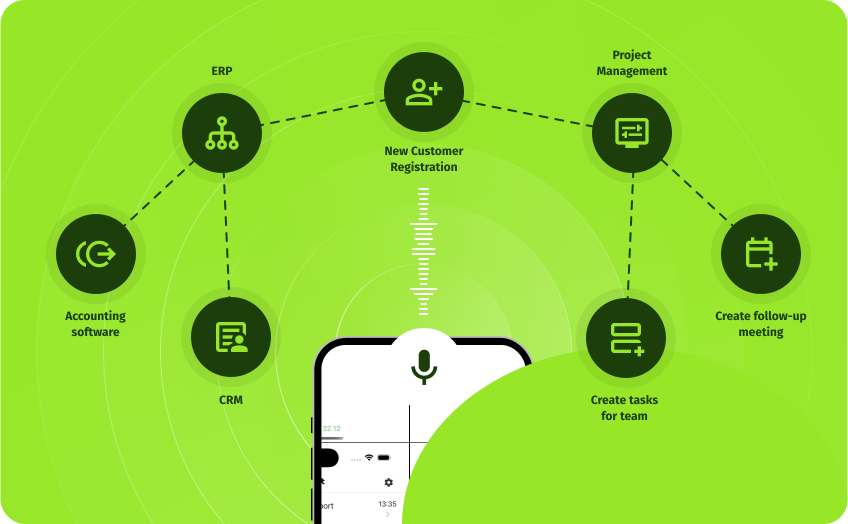
Process owner, instructions, data requirements and approvals.
User roles, agent instructions, company knowledge and workflows.
Actions through configured tools, APIs and integrations.
The outcome of the task and records of approved actions.
As priorities change
A new margin priority, customer segment or service standard: as agent numbers grow, carrying changes across the business becomes more important. Helpiner brings their execution rules into a shared environment where the relevant instructions, knowledge and workflows can be updated.
Next quarter, we want to grow without unnecessary discounts. Exceptions require a business justification and approval.
Update proposal instructions, required inputs and approval steps. After validation, the new requirements apply in the affected workflows. Your company defines the specific boundaries and permissions.
Start with one process
Choose one goal and the processes that influence it. With process owners and IT, define agent rules and agree pilot measures — such as proposals including service contracts, pricing exceptions or customer data completeness.
For example, service contract growth, margin protection or customer care.
Required details, roles, available actions and approval conditions.
Test complete and incomplete requests, access restrictions and approval steps.
Review agreed business measures, data quality and rework.
FAQ
Business Execution Governance focuses on the execution of specific work: required information, business instructions, approval and the resulting action. It complements identity, security and wider AI governance in your company.
Helpiner works with your existing systems through configured integrations. Your CRM or ERP remains the business system; Helpiner prepares and carries out the connected actions according to the agreed process.
The scope depends on the integration and the controls available through it. Governance applies to the actions and workflows configured in Helpiner. The scope for an external agent must be assessed during solution design.
Approval requirements depend on the configured process and the type of action. During implementation, agree which steps need user confirmation or approval by a responsible person and which can run automatically.
Voice is a convenient way for employees to express what they need. A configured workflow can also start from an event or a schedule. The execution rules are defined for the relevant process.
Lead the digital part of your business
Let’s choose one strategic priority and show how it can shape agents’ work across your processes. Together with leadership, process owners and IT.
Schedule DEMO
We have been with Microsoft since the beginning of our presence on the market.

Information security is our top priority, which is confirmed by the full ISO 27001 and ISO 27018 certification.

We became an SAP partner to make our systems and tools SAP-ready.